

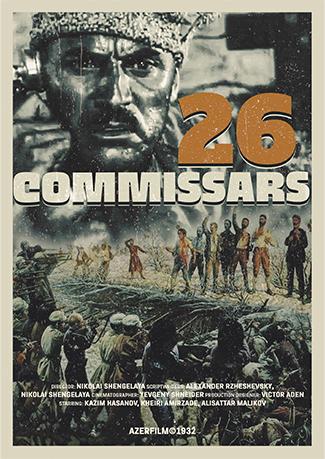
26 commissars (1932)
The film tells about the life and revolutionary activities of the Baku commissars, their efforts to create a commune in Azerbaijan.
As early as 1925, the idea of creating a “heroic” epic about the 26 Baku commissars was raised. Already in 1926, the writer Pavel Blyakhin wrote a screenplay called “The Murder of the 26 Baku Communards”. After the screenplay was discussed and approved by the Baku Committee of the AK(b)P, its production was entrusted to the “Azerdovletkino” and “MezhrabpomRus” studios. The director Sergei Eisenstein was entrusted with directing the film. Even that year, a 96-meter chronicle-documentary film called “The 5th Anniversary of the Destruction of the 26” was shot. However, due to his long trip to Germany, Sergei Eisenstein refused to direct a feature film about the 26.
The Central State Photo-Cinema Enterprise – “Goskino” sent a letter to “Azerdovletkino” on March 31, 1926. The letter stated that Moscow agreed to the joint filming of the film “26 Communards”. However, Moscow would dictate all issues, subject to agreement with Baku.
This time, Abram Room was assigned the directorship. Even the date of delivery of the finished film was specified: September 15, 1927. But a little later, on July 12, 1927, a new letter was sent from Moscow to Baku. The letter stated: “There is no director to shoot the film. Room refuses. The work is too complicated, and the production is too expensive. Therefore, we are refusing to produce this film.”
After that, the studio management held negotiations with directors Amo Beknazarov and Vsevolod Meyerhold regarding the filming of 26, and commissioned the script to be written first by screenwriter Nina Agadzhanova-Shutko, and then by Alexander Rzheshevsky. Each time, a film crew was organized, and a date for the film's release was set. However, this issue was postponed each time due to certain organizational issues.
Finally, in 1931, Georgian director Nikolay Shengelaya took over the production of the film. At that time, this film, which was considered an important work of Soviet cinematography, was not met with an unambiguous response by both film critics and cinematographers after its release. They criticized the director for not making the characters of the commissars convincing, and the film as a whole for being compositionally inaccurate and fragmentary. Even N. Lebedov wrote in his book “Essays on the History of USSR Cinema” (Moscow, 1965): “The film, shot under the direct influence of the theory of “intellectual cinema” and based on an ambiguous, unclear, “emotional” scenario, in which the main roles were created by the “types” of the performers, who did not differ in their individual characteristics, was subject to abstraction and schematicity. Therefore, it was rightly criticized. However, the tragic nature of the plot, the successful directorial solution of mass scenes (the council meeting, the scene of the shooting of the commissars), and the high level of visual culture (cameraman Y. Schneider, artist V. Aden) compensated for the film’s shortcomings to some extent.”
Another name for the film is “26 Baku Commissars”.
Director Nikolay Shengelaya was awarded an honorary decree of the Az.MIC and a gold watch with his name on it (1933, Baku).
Country:
Production:
Duration:
Age limit:
First view date:
Technical specifications:
Genre:
historical , drama , battle
Share now:


Type:
feature fiction film
Director:
Script writer:
Cinematographer:
Production designer:
Cast:
Assistant of director:
Assistant of cinematographer:
Administrator: